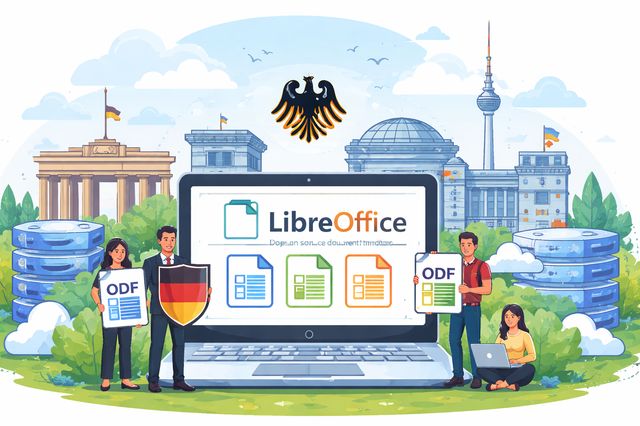
Germany's Commitment to Open Formats
The ODF format mandatory in Germany by 2028 is now a clear direction for free LibreOffice and open formats. This decision affects the entire public administration. You will understand why this choice goes far beyond just a file format.
ODF, or Open Document Format, is an open file format used for office documents. In this article, it is directly linked to public sector documents, long-term access, interoperability and the use of LibreOffice Free.
Why Germany is Mandating the ODF Format
The German state aims to regain control over its digital tools. This is necessary as it continues to rely heavily on proprietary solutions.
The government relies on a comprehensive program called Deutschland-Stack. This framework sets the rules for building an independent digital infrastructure. This is not just a technical detail; it is a political strategy.
Several clear objectives emerge:
- Reduce dependence on large foreign companies
- Ensure long-term access to documents
- Guarantee compatibility between public services
- Promote open and sustainable solutions
This choice is becoming increasingly apparent, as closed formats pose problems. They limit data access and complicate migrations.
For administrations, the file format is not a minor setting. It determines how documents are created, shared, archived and reopened over time. A common open format makes exchanges easier between services that do not always use the same tools.
Mandatory ODF: What This Means in Practice
The German administration leaves no room for doubt. It now only permits two main formats.
Here are the accepted formats:
- ODF (Open Document Format) for office documents
- PDF/UA for accessible documents
All proprietary formats, such as Microsoft files (.docx, .xlsx), are excluded from the official framework.
This change alters habits. Administrations must adapt their tools, and suppliers need to rethink their offerings.
In practice, an office document can include text documents, spreadsheets or presentations. The ODF format provides a shared basis for these files, while PDF/UA is mentioned for accessible documents.
LibreOffice Free at the Heart of This Transition
The choice of the ODF format directly promotes the use of LibreOffice Free. This software natively uses this open standard.
LibreOffice thus becomes an obvious solution because:
- It is free
- It adheres to open standards
- It works on multiple systems
- It evolves through an active community
You do not need a paid license. You can install LibreOffice Free on as many machines as you want.
This freedom changes the game, especially for public institutions.
Because LibreOffice uses ODF natively, users can create, open and save office documents in the required format without adding a separate conversion step for everyday work.
Digital Sovereignty: A Strategic Issue
Germany is not just looking to save money; it primarily wants to protect its data.
An open format allows for:
- Guaranteed access over time
- Independence from any publisher
- Improved information security
In contrast, a closed format creates dependency. You must use specific software and accept its terms.
Today, the risk has shifted. It is no longer about leaving a proprietary format but about remaining in one.
Digital sovereignty also depends on the ability to choose tools freely. When the document format is open, the administration is not limited to one software publisher to access its own files.
A Decision that Could Influence All of Europe
Germany remains Europe’s largest economy, so its choice will have an impact.
Software publishers will have to adapt; they will need to integrate ODF into their solutions. Otherwise, they will lose public contracts.
Other countries may follow suit, as the stakes are similar. Interoperability is becoming a priority.
This movement already exists but is gaining momentum. Germany is sending a strong signal.
Comparison: Open Formats vs Proprietary Formats
Here’s a simple table to understand the difference:
| Criterion | ODF Format (Open) | Proprietary Format |
|---|---|---|
| Data Access | Free and sustainable | Dependent on software |
| Cost | Free | Often paid license |
| Compatibility | Broad | Limited |
| Evolution | Collective | Decided by a publisher |
| Sovereignty | High | Low |
This table illustrates a simple point: open formats offer more freedom.
For readers who are not familiar with these terms, the key difference is control. With an open format such as ODF, the document structure is not tied to a single proprietary application. With a proprietary format, access can depend on specific software and licensing conditions.
A Gradual Rollout until 2028
Germany is not transitioning overnight. It is planning a gradual rollout.
The administrations will:
- Adapt their systems
- Train their teams
- Convert their documents
This phase is necessary as habits are entrenched. However, the direction is clear.
By 2028, ODF will become the standard in the German public sector.
This gradual approach also gives public services time to identify documents that need conversion and to check workflows that still depend on proprietary formats.
Why LibreOffice Free Becomes an Obvious Choice
LibreOffice directly benefits from this decision. This software already meets the requirements.
You can use it immediately, because:
- It handles ODF files perfectly
- It replaces traditional office tools
- It remains accessible to everyone
Additionally, LibreOffice Free is regularly updated. The community enhances its performance and compatibility.
You are not locked into a closed ecosystem. You maintain control.
For daily use, this means that documents can be created and exchanged in the format required by the framework. This is useful for teams that need to share files with public institutions while keeping a simple office workflow.
What Impacts for Businesses and Freelancers
This change does not only concern the state. Businesses must also adapt.
If you work with public institutions, you will need to:
- Provide documents in ODF
- Check the compatibility of your tools
- Adapt your internal processes
This may seem burdensome; however, it also simplifies exchanges.
You are using a common standard, avoiding reading or version issues.
For suppliers, the main practical point is document delivery. If a public service asks for office documents in ODF, internal templates, exported files and shared documents must follow that requirement.
Should You Transition to LibreOffice Now?
You can anticipate this change today, giving you a head start.
Here’s what you can do:
- Install LibreOffice Free on your machines
- Test the conversion of your documents
- Gradually train your team
This way, you reduce risks and gain autonomy.
The cost is zero, making the transition easier.
Testing before a full transition can help identify complex files that need attention. It also helps users become familiar with saving and sharing documents in ODF.
Limitations and Points of Caution
Not everything is perfect. One must remain realistic.
Some limitations exist:
- Occasionally imperfect compatibility with complex files
- Users' established habits are challenging to change
- Initial training may be required
However, these issues diminish over time. Tools improve, and users adapt.
The most sensitive documents are often those with advanced layout, complex spreadsheets or specific formatting. Checking these files early can make the transition smoother.
Towards a New Standard for Digital Documents
Germany is ushering in a new phase. Open formats are becoming a baseline, not an option.
You should view this evolution as an opportunity. It simplifies exchanges and strengthens your independence.
LibreOffice Free naturally asserts itself in this context. You can adopt it without constraints.
The main message is simple: when documents rely on open formats, they are easier to exchange, archive and reopen without depending on a single proprietary solution.
Conclusion
The mandatory ODF format in Germany changes the rules. It pushes for greater digital freedom.
You can follow this movement now. You gain control, compatibility, and simplicity.
The message is clear: open formats are essential, and LibreOffice Free becomes a logical choice.
FAQ: Can Europe Still Ignore ODF?
Why is Germany Acting Now?
Germany mandates ODF because it wants to regain control of its data. It acts now because waiting reinforces dependence on closed formats.
Will Other European Countries Follow Suit?
Yes, as pressure is increasing. Several countries are already using open formats, but Germany is accelerating the movement on a larger scale.
Are Proprietary Formats Still Viable?
Less and less so. They lock your documents in and force you to use paid tools. The risk is no longer about leaving these formats but about remaining in them.
Is LibreOffice a Credible Solution?
Yes, because LibreOffice Free natively uses ODF. You can adopt it without a license while remaining compatible with open standards.
Should You Change Right Now?
Yes, because the longer you wait, the more difficult the transition will be. By adopting LibreOffice Free today, you get ahead.

